
(this post contains massive spoilers about the show Sunny)
I spent ten years trying to write a novel without understanding how to tell the story. I had been reading a good deal of John Steinbeck and it influenced everything I wrote. I was young enough that I did not see this influence until I shared my writing with others and they told me, without pity, that I was aping his work.
I’m sure most writers go through this and while discovering that your influences are contaminating your writing can be painful I think it’s a necessary step in finding your own voice.
For me I was trying to capture a specific place, Saint Albans, Vermont and give it the same sense of scope and importance that Steinbeck gives the Salinas Valley in the first chapter of East of Eden. After struggling with that I then attempted to construct a narrative that shifted from first person to third and incorporated secondary source materials (mostly newspaper articles but also journal entries and handwritten notes) to create a story about a church that was torn down in 1991.
I am explaining all of this because after ten years I realized two things: 1) the story did not work and 2) I don’t like reading this kind of story. I’m sure you have encountered this in novels although I feel it’s more common in television shows and movies now – the narrative that shifts dramatically or puts on the brakes each time it starts to gain momentum. You follow a character and just as they are about to make some sort of breakthrough you shift to someone or something else.
This problem became apparent when I created a map to help keep my place in the story because it went in enough directions that without a guide I was too confused to know what to write next. Which was when I decided to simplify everything, ditch the secondary sources and tell the story in a linear fashion from one point of view.
For a book you haven’t read you’ve heard a lot about it and I thank you for being patient.

This past week I watched the show Sunny on Apple TV. I started watching Sunny several months ago and stopped ten minutes in as I was certain I would not like it (despite the trailer looking promising). Since removing social media from my life a month ago I have been more interested in all forms of film and television and this prompted me to make a new attempt with the show.
To keep things short and sweet – I think Sunny is a failure of a television show. The reasons why I think this are many but rather than write a long-winded rant about this show specifically I’d like to incorporate my earlier mentioned lessons learned and apply them to Sunny.
It was only after watching the second episode of Sunny I became aware it is based on a novel called The Dark Manual. Looking online I have discovered that The Dark Manual is now out of print (published by Betimes Books 2018) but can be purchased as Sunny (published by Mariner Books 2023). Had I known this show was adapted from a novel I would have read the novel first.
As such, I have read the first page (because it was a sample and all I needed to see) and it is apparent that in adapting the work for the screen Katie Robbins decided to shift the focus of the story from Homebots (personal robot companions in near future Japan) to Suzie Sakamoto, wife of Masa Sakamoto and mother of Zen Sakamoto. This is important in terms of the story being told as Sunny is in fact a homebot made by Masa and sent to Suzie.

What’s important to understand about Sunny (the show) is that Sunny (the homebot) should be the main character (or Masa) and she’s not. The central premise of this show is that Masa was a lost and lonely man who came to understand that homebots (something he helped reinvent and improve) could help human beings (re)connect with others. This concept is buried in a complicated narrative filled with red herrings and plot twists that are both unnecessary but are also nonsensical.
The inciting incident of the show is a plane crash and Zen and Masa were meant to be on the plane. So Suzie, with her mother-in-law Noriko, are dealing with the airline in order to determine if their remains or belongings have been found. Understandably Suzie is distraught and wallowing in misery.
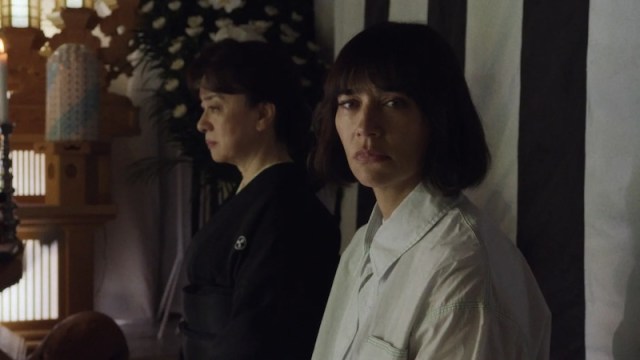
Which is when a man Suzie does not know appears with Sunny the homebot. The man claims Masa designed Sunny for Suzie. Only Suzie believes Masa works in refrigeration at his job since he’s never mentioned working with homebots before (because they are well known). The show never clarifies why Masa kept his actual work from Suzie but his sending Sunny to her is twofold: 1) Sunny has dangerous code inside of her that must be kept out of the hands of those who would use it to commit terrible acts and 2) because Suzie will be lonely without her husband and son. Only the show never clarifies how he knows she will be alone because he could not have foreseen the plane crash and he and Zen could not have been on the plane as Zen is alive and well at the end of the story!!
I didn’t keep my word and went into the story. I could not help it, for it is so poorly told and I am deeply irritated by it. To say season one concludes with numerous unresolved/unexplained issues is an understatement. There is no closure or understanding or sense of catharsis in having gone through ten episodes of Sunny. There is a lot of mental finger pointing and saying, “Wait, if they did that then…” because so little of the show holds up once you have the entire story.
Which is why I started with the long description of my failed first take at a novel. I think many people can get lost in a convoluted structure and not realize the story they are telling makes little sense or doesn’t have an actual plot. If Sunny were told in a linear manner, with a consistent viewpoint (because we bounce around between many of the characters with nothing anchoring us in place – which should mean knowledge is easy to come by because our perception is not limited) it would be easy to spot the holes in the story.
Case in point: Noriko decides to shoplift, openly, in order to be put in prison. Her reason for doing this is never made clear and only benefits the story due to chance circumstances she could not have predicted. It is, by definition, bad storytelling. That the season ends with her in prison and nothing in place to help her isn’t even a consideration due the myriad of unresolved issues.

Perhaps it’s my age or finally finding my own voice which prizes clarity over cleverness but watching a show like Sunny reminds me how easy it is to lose your way when your focus isn’t on your characters and being truthful to their stories. For the longest time I thought E.B. White wrote “Do not use five words when three will do” in the Elements of Style. Ten minutes of looking online yields the line “Don’t use seven words when four will do” from Ocean’s Eleven (Brad Pitt’s character says it) which makes me even happier. Because having it come from a more common source reinforces the point – being wordy and complicated isn’t better.
When Jorge Luis Borges writes about not longer looking for new metaphors for the moon he’s saying focus on the important part of writing. We’ve got enough moon metaphors, everyone gets it.
If there is any kind of conclusion to give a post like this it’s to reiterate what I’ve already said – know what your story is and try and find the best way to tell it. If your story is a lonely man reconnects to other people via robots then maybe you make the man your main character. Or if you name the show after the robot you make her the main character. Or if you have a mother losing her mind for ten episodes wondering if her child is alive you, perhaps, give her screen time to reconnect with her child and find out what actually happened (that’s not even a writer thing but a parent thing – really could have used that with this show).
Sunny has a retro-futuristic look and feel with a darkly comedic tone that is offset by enigmatic characters who never become known to the audience. As someone who has spent some time editing a considerable amount of video footage I cannot help but wonder, did they not have time for reshoots? Did they make no attempts to reorganize the footage and reshape the story? So much of editing is watching and rewatching the footage, and I find it impossible to believe that this show made sense to those doing this.

Steven Soderbergh gave a speech in 2013 at the San Francisco Film Festival which at the time received a good deal of press. In part this is because it was critical of the film industry and called into question a number of commonplace practices. In rereading the speech the following felt apropos:
And sometimes when you get a really good artist and a compelling story, you can almost achieve that thing that’s impossible which is entering the consciousness of another human being – literally seeing the world the way they see it. Then, if you have a really good piece of art and a really good artist, you are altered in some way, and so the experience is transformative and in the minute you’re experiencing that piece of art, you’re not alone. You’re connected to the arts. So I feel like that can’t be too bad.
(you can read the full speech here – https://www.indiewire.com/news/general-news/read-the-full-transcript-of-steven-soderberghs-impassioned-state-of-cinema-address-from-the-san-francisco-film-festival-38993/
Which is feel is the message this show was trying to put forth. I think how the story was told simply got in the way, which is a shame.

 The Writings of John Ryan Sullivan
Leave a comment